Extensions
Nine extensions, written by us, shipped with the browser.
Not a store full of abandoned uploads asking for permission to read everything you do. First-party features, built on the same capability plane and gated by the same security kernel as the agent.
Why first-party
The features you need most are the ones that need the most access.
The browser extension model has an unhappy shape: the features people need most — blocking ads, automating a task, fixing their writing — are the ones that need the most access, delivered by third parties with the least accountability. Then a platform changes its rules and the ad blocker gets quietly weakened.
Tepegöz builds those features itself, in the repository, under the same review as everything else. When an extension needs to act on a page, it goes through the same policy kernel the agent does. Nothing gets a private back door.
Every one of these can also be driven by the agent through a declared capability contract — so "block ads on this site" or "run my invoice macro" is a sentence, not a menu hunt.
The nine
Every one ships enabled, and every one is removable.
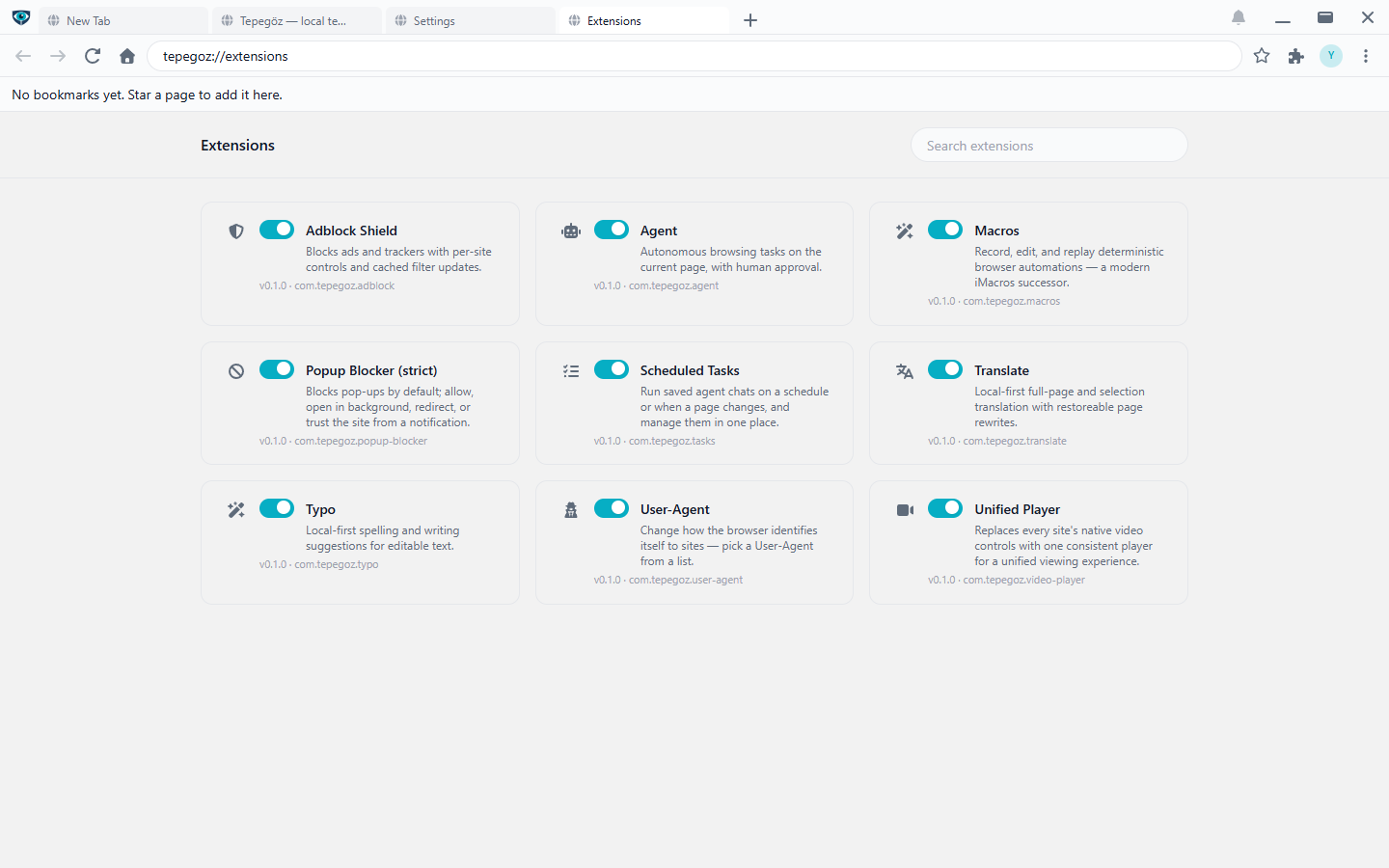
Adblock Shield
Ad and tracker blocking with cosmetic filtering, applied per session partition — including inside a tunnelled tab, in the same order, with no system-wide proxy interception anywhere. Because Tepegöz is not a Chrome extension, it is not subject to the platform restrictions that hollowed out blockers elsewhere.
Agent
The sidebar where you hand work to the browser, and the surface that actually drives it: the conversation, the plan, the live step feed, and the approval prompts. This extension also ships the command palette, whose Do, Make and Tasks modes are still empty — the tabs are there, the commands are not, and a goal typed into the palette does not start a run.
Macros
A deterministic successor to iMacros: record what you do, edit it as steps, replay it — with no model in the loop, so the same macro does the same thing every time. Two surfaces: a resizable Macro Studio beside the live page, and a manager for everything you have saved. The agent can list, run and save macros too.
Popup Blocker (strict)
Blocks pop-ups by default and, instead of silently swallowing them, offers the choice inline on the notification: allow, open in the background, follow the redirect, or trust this site.
Scheduled Tasks
Work that runs on a schedule instead of when you are watching — with the same approval rules, so an unattended run can spend only inside a wallet mandate you wrote, and still cannot delete things on its own.
Translate
Full-page and selection translation, local-first: translation memory first, then an on-device model if you have one installed, and only then a cloud fallback you have approved. The page rewrite is restoreable — original nodes are kept and can be put back, rather than the destructive replacement that breaks single-page applications.
Typo
Writing and spelling help for editable text on any page, analysed locally. Dictionaries are downloaded into your profile on demand, pinned by version and verified by hash — not bundled, not uploaded, not sent anywhere for "review".
User-Agent
Change how the browser identifies itself, from built-in presets across Chrome, Edge, Firefox and Safari on Windows, macOS and iPhone — per site or globally.
Unified Player
One consistent video player across sites, replacing whatever each page ships.
Screenshots of the nine extension panels
None of the nine have been photographed yet. Every shot has to come from a running build with that extension open and actually doing something, which is nine separate sittings rather than one afternoon. Nothing is standing in for them here — not an icon, not a mockup — so the count above is what exists, and it goes up one panel at a time.
Third-party extensions
What about the ones you already use?
Limited Chrome MV3 support is planned, with an honest compatibility matrix rather than a promise that everything works — because it will not, and finding that out one extension at a time is a bad experience.
Deep integrations that need real access, like password managers, are planned as native adapters instead of extensions. An extension is the wrong trust boundary for your credentials.